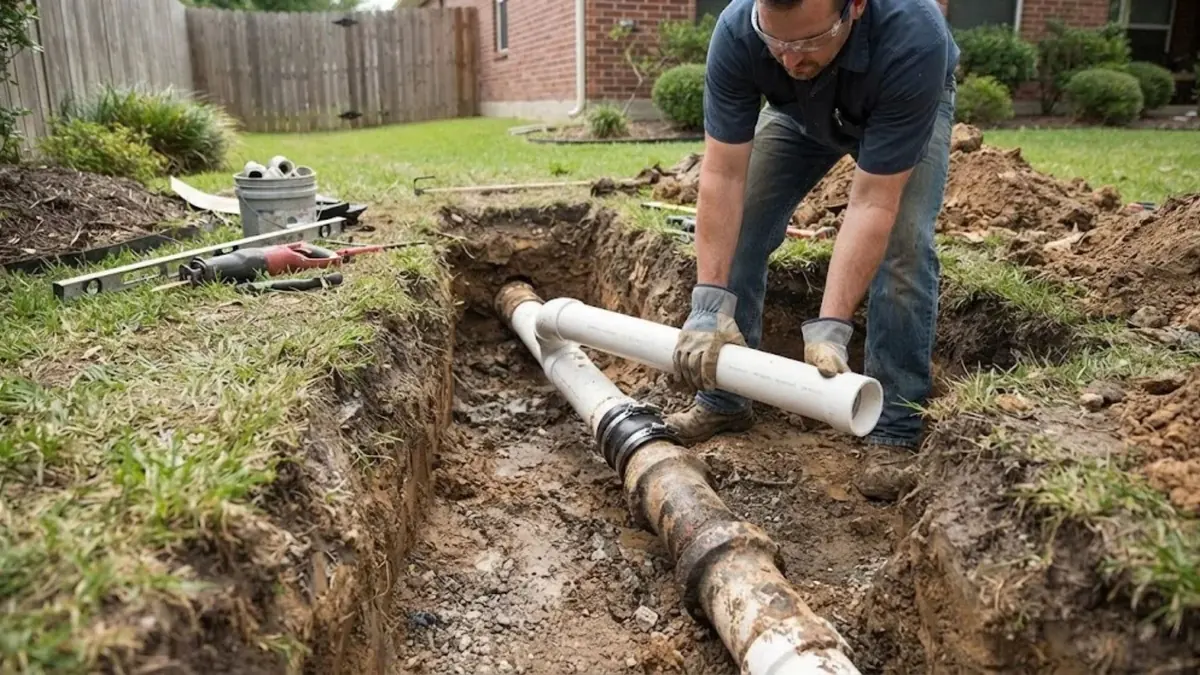
A sewer line leak is repaired in one of three ways. A damaged section can be dug up and replaced, a liner can be cured inside the old pipe, or the whole line can be replaced. Which one fits depends on what a camera shows about the break, the pipe material, and how much of the line is damaged. Nobody can choose well without seeing inside the pipe first.
The first step is usually a camera look, which a plumber does as part of a sewer inspection. From there, a repair plan makes sense. The rest of this guide covers the clues, the options, and what the Village requires before work starts.
Clues that the line is leaking or broken
- Several drains back up or gurgle at the same time, especially the lowest drain in the house.
- A sewage smell in the yard, basement, or near a floor drain.
- A soggy, sunken, or unusually green strip of lawn between the house and the street.
- Repeated clogs that clear with a snake and come back within weeks.
- Rodents or insects appearing near a drain or cleanout.
- Cracks in the slab or foundation, or a small sinkhole above the line.
Winter adds one more factor. Freeze-thaw cycles in the Chicago south suburbs move the soil, and shifting ground can pull an old joint apart. If a leak shows up in late winter or spring, a camera check after the thaw is a sensible time to look. In the meantime, avoid pouring grease or running heavy water loads, such as back-to-back laundry, while the line is suspect.
One of these signs does not prove a broken line. A single slow drain is far more often a trap or branch clog. When several signs show up together, or a snake keeps hitting something at the same distance, the main line becomes the suspect.
What a camera can and cannot show
A camera on a flexible cable travels down the line from a cleanout and records what it sees. It shows cracks, offset joints where sections have slid apart, root hairs poking through, bellies where the pipe sags and holds water, and collapsed segments. The plumber can also use a locator to mark the camera depth on the surface.
There are limits. Heavy grease or debris may need to be cleared first, and a fully collapsed pipe stops the camera. We cannot see through the pipe wall, so tiny leaks that weep at a joint may only show as stained soil or wet stains. A camera run gives strong evidence, not a perfect picture.
| Option | How it works | Good fit when | Limits |
|---|---|---|---|
| Spot repair | Dig to the break, cut out the bad section, and join new pipe | One short damaged area and clear access | Does not help if the rest of the line is also failing |
| Pipe lining | A resin-soaked liner is pulled in and cured to form a new pipe inside the old one | Cracks, small offsets, and root entry in a pipe that is still round | Not for collapsed or badly bellied pipe, and it reduces the diameter slightly |
| Pipe bursting | A cone pulls new pipe through while breaking the old one outward | Old pipe with long damaged stretches | Needs entry and exit pits and clear nearby utilities |
| Full replacement | Trench out the old line and lay new pipe | Collapsed, bellied, or heavily rooted lines | Most digging, restoration of lawn or paving |
No option is permanent in every case. A liner seals the pipe it lines, but it does not fix a bad connection at the house or the street tap. A spot repair leaves older neighboring pipe in place, and that pipe may fail next. Ask the plumber to explain what stays old after the work is finished.
Practical tip: save the camera video
Ask for the recording and a note of how far down the line each problem sits. A second plumber, the Village, or your insurance contact may want it. It also gives you something to compare against after the repair is done.
Rather have a plumber look at it?
Describe the problem on the phone and ask for a same-day appointment when one is available.
Why the pipe material matters
Older sewer lines in many neighborhoods are clay tile, cast iron, or a fiber pipe nicknamed Orangeburg. Clay joints let roots in, cast iron rusts from the inside, and Orangeburg softens and deforms over time. Modern lines are usually PVC, which is smooth and watertight at the joints.
Check your home's build year before you assume anything, since age alone does not tell you what lies underground. A camera will tell you what is actually there. That is the main reason a camera visit usually comes before any quote for sewer line repair.
Budget, timing, and what drives the cost
Costs vary with depth, length, access, and surface restoration. A line under a driveway or tree costs more to reach than one in open lawn. Lining often avoids a long trench, while a collapsed line leaves no choice but digging.
Ask whether the quote includes the permit, cleanout installation, and restoration of lawn or concrete. A clear written scope avoids surprises later. If you are comparing bids across the area, plumbers who serve Chicago Heights or University Park face the same questions about access and permits in their own towns.
Park Forest permit rules before sewer work
The Village Building Department at 350 Victory Drive says sewer repair permits cover the installation of cleanouts. A cleanout is the capped access pipe that lets a camera or cable enter the line, so adding one is part of many repairs and it counts under the permit. The Village adopts the Illinois State Plumbing Code, and the plumber should follow it.
All contractors working in Park Forest must be Park Forest licensed, so ask to see proof before work begins. A permit is also required if a homeowner does the work, and in that case a waiver form is submitted. If a contractor pulls the permit, the homeowner signs the proposal or application. Permits are not accepted by email or online, so the paperwork is dropped off or mailed. Separately, the Village is replacing its own wastewater lines, which means work in the street may happen on its side while your private line is still your responsibility.
Questions we hear
Look for several drains backing up together, a sewer smell, soggy or sunken lawn, and repeated clogs. A camera inspection confirms whether the pipe is cracked, offset, or full of roots. No single sign is proof on its own.
Lining avoids a long trench and can seal cracks and small joint gaps. It does not fit every pipe. Collapsed or sagging sections, and some bends, need digging. The camera video helps decide which method works.
Roots do not break good pipe, but they enter through cracks and loose joints in search of water. Once inside, they grow and widen the gap. Cutting roots clears the line for a while, while repairing the joint stops the cycle.
It depends on the method and the access. A spot repair or lining can take a day or less once the work begins, while a full replacement can take longer. Permits, locating utilities, and weather also affect timing.
Yes. The Village Building Department says a permit is required whether a homeowner or a contractor does the work, and sewer repair permits cover installing cleanouts. Contractors must be Park Forest licensed. Permits are dropped off or mailed to Village Hall, not accepted by email or online.
Yes. The Village Building Department says a permit is required whether a homeowner or a contractor does the work, and sewer repair permits cover installing cleanouts. Contractors must be Park Forest licensed. Permits are dropped off or mailed to Village Hall, not accepted by email or online.
Standards and sources
Written by the Park Forest Express Plumbing team. Plumbing work in Illinois follows the Illinois Plumbing Code, 77 Ill. Adm. Code 890, which the Village of Park Forest adopts. Local statements on this page come from Village of Park Forest pages, and the Building Department states that a permit is required whether you or a contractor does the work. Before you hire anyone, check the license on the Illinois Department of Public Health license verification tool.