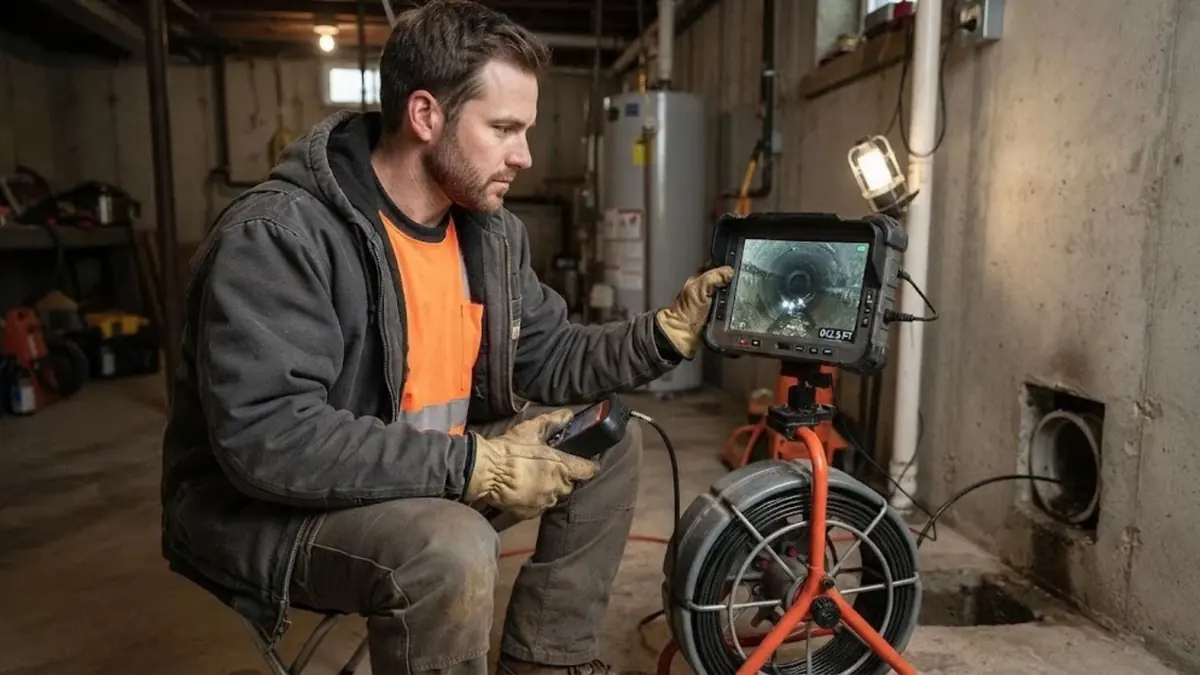
A sewer line inspection is a camera survey of the pipe that carries waste from your house to the street. A technician feeds a small waterproof camera on a flexible cable into the line, usually through a cleanout, and watches live video of the pipe walls. The goal is to find damage, roots, bellies and blockages before they cause a backup.
Most inspections take a modest part of a visit and leave your yard intact. You get a clear answer about what is wrong and where, so repairs can be limited to the failed section. It is a look inside the pipe, and not a repair.
How the visit usually runs
Find a way into the line
The camera enters through a cleanout, a capped fitting on the main drain. If none exists, the technician may pull a toilet or use a roof vent, and a missing cleanout is itself a finding.
Run the camera downstream
A push cable carries the camera toward the street while a light shows the pipe interior. The technician narrates what appears on the monitor and pauses at anything unusual.
Locate the problem on the surface
The camera head carries a transmitter. A handheld locator above ground picks up its signal and reports the depth, so a crew knows where to dig if a repair is needed.
Record and review
Video and notes are saved, and the technician explains the findings in plain language. Ask for a copy of the video, since it helps with quotes and with sellers.
Reading the findings
Pipe material changes what the camera sees. Clay tile shows offset joints and root hairs, cast iron shows flaking and scale, and plastic pipe shows sags or deformed walls. The table pairs common findings with what they usually mean.
| What the camera shows | What it usually means | Typical next step |
|---|---|---|
| Roots entering at joints | Joints have opened enough to let moisture and roots in | Cut the roots, then watch for regrowth or repair the joint |
| Standing water in a low section | A belly where the pipe has settled | Monitor, or replace that section if waste collects |
| Cracked or broken pipe | Soil or ground movement has fractured the wall | Spot repair or replacement |
| Heavy scale or flaking | Aging cast iron narrowing the bore | Cleaning, and a plan for eventual replacement |
| Offset or separated joint | Two pipe sections no longer line up | Spot repair |
| Clean walls, steady flow | No visible defect at the time | Keep a copy as a baseline |
A belly is not always urgent. Water can sit in a shallow sag for years and the line still drains. The record matters more than a single frame, since a repeat camera run in a year or two shows whether the defect is growing.
Why buyers order one before closing
A home inspector sees fixtures and visible piping, not the buried line. If a house is older or has large trees near the line, a sewer camera run before closing can reveal costly surprises while you still have room to negotiate. A replaced main can be a major expense, so many buyers want the facts first.
Sellers sometimes order their own inspection to head off questions. Either way, ask who owns the report, and confirm the video covers the full run from the house to the connection at the street. A clip that stops partway answers only part of the question.
Rather have a plumber look at it?
Describe the problem on the phone and ask for a same-day appointment when one is available.
What a camera cannot tell you
The camera sees only the pipe it can reach. It cannot see through a full blockage, so a line packed with debris may need cleaning first with a hydro jet or cable machine before the inspection can continue. Sharp bends can stop the camera, and a section beyond a collapse stays hidden.
- It cannot judge soil conditions around the pipe.
- It cannot measure slope to an exact number the way a survey instrument can, though it shows low spots.
- It cannot see inside the municipal main past the connection.
- It cannot predict how long an old pipe will last, only its condition today.
- It may miss a hairline crack that closes when the pipe is dry.
Take the report as a snapshot. If a finding is unclear, ask the technician to show the footage again or run a second pass after cleaning.
Before the technician arrives
Find your cleanout and clear a path to it. Skip heavy flushing right before the visit, because a wet, full line can hide defects, and tell the technician about past clogs, odors or slow drains so they know where to look.
When an inspection makes sense
| Situation | Why a camera helps |
|---|---|
| Repeated clogs in the main line | Shows whether roots, a belly or a break is behind them |
| Gurgling, or sewage smell outdoors | Can point to a cracked or open section |
| Buying an older home | Documents condition before the sale closes |
| After a backup | Shows what failed and whether the line is still blocked |
| Before a landscaping project | Confirms where the line runs and its depth |
When a problem is found, the next step is a fix sized to the damage. Our sewer inspection service covers the camera work, and when a section has failed, sewer line repair options range from spot repair to replacement depending on what the video shows.
Park Forest note: sewer backups and permits
The Village of Park Forest says urban flooding happens when rain falls faster than the ground can absorb it and sewers cannot handle the runoff, which can cause sewage backups in basements. The Village is replacing its wastewater lines, which are the public mains in the street. A camera inspection covers your private line up to the connection, so it tells you whether a backup is a problem on your side or one to report to the Village.
The Village flooding page also asks residents not to flush or pour fats, oils, wipes or paper towels, following Metropolitan Water Reclamation District guidance. Those items catch on rough pipe and roots, which is exactly where a camera often finds trouble. Sewer repair permits at the Building Department, 350 Victory Drive, cover installing cleanouts, and a contractor must be Park Forest licensed. Nearby, the same questions apply in Olympia Fields, where permanent homes date to around 1919, and in University Park, incorporated in 1967, so check each home's build year to judge how old the pipe may be.
Questions we hear
Many inspections are done in a modest part of a visit once the technician reaches the line. Time depends on the length of the run, how easy the cleanout is to reach, and whether a clog must be cleared first. A long or blocked line takes longer.
No digging is needed for the camera run. The camera goes in through a cleanout or fixture. Digging comes only later, if a repair is needed, and the locator helps limit the dig to the failed section.
It can show cracks, open joints and root intrusion, which are common leak points. It cannot always confirm that water is leaving the pipe. For water supply leaks inside walls or slabs, other methods are used.
It is a smart step for older homes or lots with mature trees, since the buried line is outside a standard home inspection. Ask for the full video and make sure it covers the line out to the street connection.
Sewer repair permits at the Village Building Department cover installing cleanouts, so ask them before work starts. Contractors in the village must be Park Forest licensed. Permits are dropped off or mailed, not taken by email or online. A cleanout also makes future camera work easier.
Sewer repair permits at the Village Building Department cover installing cleanouts, so ask them before work starts. Contractors in the village must be Park Forest licensed. Permits are dropped off or mailed, not taken by email or online. A cleanout also makes future camera work easier.
Standards and sources
Written by the Park Forest Express Plumbing team. Plumbing work in Illinois follows the Illinois Plumbing Code, 77 Ill. Adm. Code 890, which the Village of Park Forest adopts. Local statements on this page come from Village of Park Forest pages, and the Building Department states that a permit is required whether you or a contractor does the work. Before you hire anyone, check the license on the Illinois Department of Public Health license verification tool.