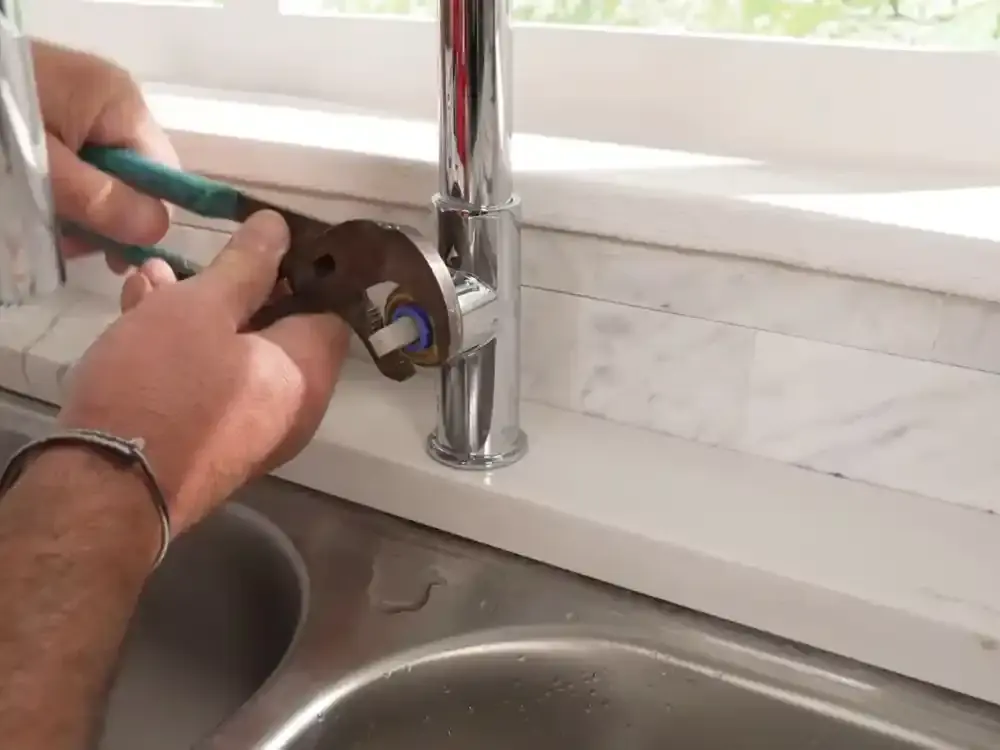
Repair it or replace it
Repair the faucet when it drips or squeaks but the body is solid, the finish is intact and parts are still sold for it. Replace it when the body is pitted or cracked, the spout leaks at the base, or the faucet is old enough that no cartridge fits. A new cartridge or washer is a short job, while a full faucet swap takes most of an afternoon for a first-timer.
The deciding factor is usually the part that leaks. A drip from the spout tip is typically a worn seal inside, and a puddle at the base points to worn O-rings or a cracked body. Corrosion that you can scrape with a fingernail means the metal itself is failing.
| What you see | Likely cause | Usual answer |
|---|---|---|
| Steady drip from the spout | Worn washer, seat or cartridge seal | Repair |
| Water around the base of the spout | Worn O-rings | Repair, unless the body is cracked |
| Weak flow from one side | Clogged aerator or debris in the cartridge | Clean or repair |
| Handle is stiff or loose | Worn cartridge or set screw | Repair |
| Green or white crust, pitted metal | Corrosion in the faucet body | Replace |
| Leak under the sink at the supply line | Failed line or loose nut | Replace the line, then retest |
Know the cartridge type before you shop
Four designs cover most home faucets. Knowing which you own saves a second trip to the hardware store, and the brand name is usually printed under the handle or on the box you may still have.
Compression
Two handles that you tighten to stop the water. A rubber washer wears out against the seat, which is why these drip. Washers are cheap and easy to swap.
Ball
A single handle over a slotted ball, common in older kitchens. Leaks usually come from worn seats and springs, and kits replace them together.
Cartridge
A single or double handle moving a brass or plastic cartridge. The cartridge is the whole mechanism, so replacing it fixes most drips.
Ceramic disc
Two ceramic plates slide to meter flow, found in many modern faucets. They last long, and when they leak the cylinder is replaced as one piece.
Rather have a plumber look at it?
Describe the problem on the phone and ask for a same-day appointment when one is available.
Tools and parts to gather first
- Adjustable wrench and a set of hex keys for set screws under the handle.
- A basin wrench, which reaches the cramped nuts behind a sink bowl. A regular wrench cannot get up there.
- Plumber's tape, a bucket, a flashlight and a rag to cover the drain so small parts do not fall in.
- New braided stainless supply lines if the old ones are stiff, kinked or more than a few years old.
- Plumber's putty or the gasket that comes with the new faucet, depending on the base design.
Installing a new faucet, start to finish
Shut off the water
Turn the two angle stop valves under the sink clockwise. Open the old faucet to drain the lines and confirm the water is off. If a stop will not turn or leaks when moved, stop there, because forcing an old valve can start a worse leak.
Disconnect and remove the old faucet
Loosen the supply nuts and the mounting nuts with a basin wrench. Lift the faucet out, then scrape the old putty or gasket from the sink surface so the new base sits flat.
Mount the new faucet
Feed the new faucet through the holes and tighten the mounting nuts from underneath. Check that the spout is straight and that the base is snug before you finish tightening.
Connect the supply lines
Hand-tighten the braided lines to the faucet and to the stop valves, then add a quarter turn with a wrench. Over-tightening crushes the rubber washer inside the nut and causes the very leak you are trying to avoid.
Flush and test
Remove the aerator, open the faucet and both stops, and let the water run for a minute to push out debris. Then replace the aerator and check every joint with a dry paper towel.
Practical tip
Take a photo of the plumbing under the sink before you start, and bring the old supply line and cartridge to the store. A matching part in your hand beats a guess about sizes, and the photo helps if you forget how a mounting plate fits back together.
Signs the job is bigger than the faucet
Call a plumber if the shutoff valves will not close fully, if the sink sits on a rotted cabinet floor, or if the supply stubs coming out of the wall are corroded or loose. Those parts are behind the faucet, and replacing a faucet on top of a failing valve just moves the leak. We cannot judge the pipe behind a wall without opening it, but we can tell you whether the visible parts are sound.
Our faucet repair service covers worn cartridges, seats, and fixtures that leak under the sink. For a new faucet, a relocated sink, or work that touches supply and drain pipes, plumbing installation is the better match, since those jobs involve fitting and sometimes a permit.
Park Forest note: licenses and permits when you hire
The Building Department at 350 Victory Drive states that all contractors doing work in the Village of Park Forest must be Park Forest licensed. It also says a permit is required when you do the work yourself and when you hire a contractor. For anything beyond a like-for-like faucet swap, call Village Hall at 708-748-1112 and ask if your job needs one, because permits are dropped off or mailed rather than taken by email or online.
Illinois also requires people who install, alter or repair plumbing to be licensed. Plumber license numbers begin with 058, and plumbing contractors register with the state with numbers that begin with 055. You can look up a license on the Illinois Department of Public Health license verification tool before you sign anything. A contractor who cannot give you a number is a reason to keep looking, and the Village adopts the Illinois State Plumbing Code for work that does get permitted. Neighbors in Olympia Fields and Chicago Heights follow their own village or city rules, so confirm locally if the property is across the line.
Questions we hear
If the faucet drips from the spout when closed, or the handle feels loose or gritty, the cartridge or seat is the most likely culprit. Shut off the water, pull the handle and cartridge, and compare them to a new part. A cracked or pitted body is a sign to replace the whole faucet.
Usually yes. The mounting and supply nuts sit behind the sink bowl in a space where a regular wrench will not turn. A basin wrench has a pivoting jaw on a long shaft and costs far less than a plumbing call, though the job still takes patience.
Yes, in most cases. Old rubber or stiff braided lines are cheap compared with the damage from a burst line under a cabinet. New lines also fit the new faucet's connection size correctly.
Do not force them. A seized stop valve can snap or start leaking. Shut off the water at the main valve instead and have a plumber replace the stops before the faucet job.
The Village says a permit is required for work you do yourself and for work a contractor does, but it does not list every small job. Call the Building Department at 708-748-1112 before you start a bigger plumbing job, and ask whether a simple faucet replacement needs one.
The Village says a permit is required for work you do yourself and for work a contractor does, but it does not list every small job. Call the Building Department at 708-748-1112 before you start a bigger plumbing job, and ask whether a simple faucet replacement needs one.
Standards and sources
Written by the Park Forest Express Plumbing team. Plumbing work in Illinois follows the Illinois Plumbing Code, 77 Ill. Adm. Code 890, which the Village of Park Forest adopts. Local statements on this page come from Village of Park Forest pages, and the Building Department states that a permit is required whether you or a contractor does the work. Before you hire anyone, check the license on the Illinois Department of Public Health license verification tool.