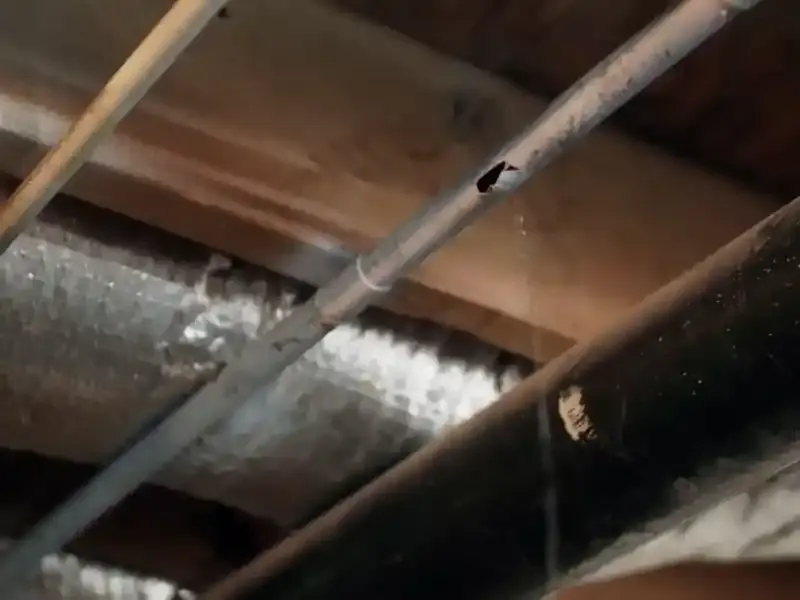
When no water comes out of a faucet during a cold spell, a pipe is probably frozen. Open the tap, find the frozen section, and warm it slowly with a hair dryer or a heating pad. Never use an open flame. If you see a crack, a bulge or water spraying, shut off the main valve and call a plumber.
Frozen pipes are a matter of timing. Ice blocks flow and builds pressure between the ice and the closed faucet, which is where pipes split. The pipe often bursts as it thaws, so watch for leaks once the water returns.
First minutes: confirm it is frozen and locate it
Check whether other taps are affected. If only one faucet is dry, the freeze is on that branch. If every tap is dry, the freeze may be near the main entry, or the supply may be off.
Look at pipes in cold spots first. These include exterior walls, crawl spaces, unheated basements, garages and the area under a kitchen or bath sink on an outside wall. A frozen section may feel very cold, look frosted, or show a slight bulge.
| Location | Why it freezes | First move |
|---|---|---|
| Under a sink on an outside wall | Cold air reaches the pipe behind the cabinet | Open the cabinet doors and warm the room |
| Unheated basement or crawl space | Little heat, drafts at rim joist | Add a safe heat source and seal drafts |
| Garage supply lines | Garage temperatures follow the outdoors | Warm the pipe area and keep the door shut |
| Outdoor hose bib and its supply | Water left in the line expands | Shut the interior valve and drain the spigot |
| Pipe in an exterior wall | Insulation is thin or missing | Raise indoor heat, open nearby cabinets |
Thawing it without making things worse
Open the faucet
Leave the tap open so melting water and steam can leave the pipe. It also relieves pressure and shows you when flow returns.
Apply gentle heat
Start at the faucet end and work back toward the frozen part. Use a hair dryer, a heating pad wrapped on the pipe, or warm towels soaked in hot water.
Keep heating until full flow
Do not stop at a trickle, since ice may still be inside. Wait until the water runs strong.
Check the whole line
Look along the pipe and the ceiling and walls below for drips or stains. A split pipe may only show once the ice melts.
| Method | Verdict | Reason |
|---|---|---|
| Hair dryer | Safe | Gentle and controllable |
| Heating pad or warm towels | Safe | Even heat, low fire risk |
| Space heater aimed at the area | Use with care | Keep clear of cabinets and keep it supervised |
| Propane torch or open flame | Never | Starts fires and can damage the pipe |
| Boiling water poured on the pipe | Avoid | Can crack a cold pipe and scald you |
| Pouring chemicals into the line | Avoid | Does not melt ice in supply pipes |
If the pipe cracks
Turn off the main water valve at once and open the faucets to drain the lines. Shut off the electricity to any room where water is spreading near outlets, and move belongings out of the wet area.
A pipe that has split needs repair, not just thawing. Our burst pipe repair page covers what happens after a rupture. You might not see the damage right away, so after a freeze, a leak detection visit can find slow drips hidden in walls or ceilings.
Rather have a plumber look at it?
Describe the problem on the phone and ask for a same-day appointment when one is available.
Preventing the next freeze
Insulation is the cheapest barrier. Foam sleeves on exposed pipes in basements and crawl spaces cost little and slow heat loss. Seal gaps where pipes pass through walls, since a small draft can freeze a pipe even when the room feels warm.
During a cold snap, open cabinet doors under sinks on outside walls so house heat reaches the pipes. Let a faucet drip, since moving water is slower to freeze and a drip relieves pressure. Keep the heat on, and avoid setting the thermostat very low when you leave, with 55 degrees a common minimum.
- Disconnect garden hoses and drain outdoor spigots before the first hard freeze.
- Insulate pipes in unheated spaces, and seal drafts near them.
- Fix cracks in foundation walls and around pipe penetrations.
- Know where your main shutoff is, and test it so it turns freely.
- Before a trip in winter, leave the heat on and ask someone to check the house.
A frost-free hose bib has a longer stem that puts the shutoff inside the heated wall. It still needs the hose removed in winter, because a connected hose traps water at the spigot. If your home has an older bib, replacing it before winter is a sensible job.
When to call a plumber
Call if you cannot find the frozen section, if the pipe is inside a wall or under a slab, or if you see any bulge, crack or leak. Heat applied behind drywall without knowing what lies there is risky. Call (855) 575-2890 if a pipe has burst, and shut the main valve while you wait.
Park Forest note: knowing who shuts off your water
A burst pipe is easier to handle if you know where to stop the water. Inside the house, that is the main valve. The Village of Park Forest supplies the water, so for questions about the main valve or the shutoff near the meter, call Village Hall at 708-748-1112. The Water Department keeps extended hours until 8 pm on Mondays, and Village Hall is open 9 to 5, Monday through Friday.
Ask the Village who operates the curb stop, the valve between the street main and your service line, since it is usually not yours to turn. Winters in the Chicago south suburbs bring freeze-thaw cycles, so the question is worth settling in autumn. The same idea applies next door. In University Park, water is supplied by Aqua Illinois, a private utility, so ask Aqua about the shutoff. In Olympia Fields, ask the Village which supplier serves your address and who operates the shutoff.
Questions we hear
It varies with the pipe, the length of the freeze and how much heat you can apply. Gentle heat on a short section may take under an hour, while a long or hidden freeze takes much longer. Keep the faucet open throughout.
No, but the risk is real. Ice expands and raises pressure in the closed pipe, and the split often forms between the ice and the faucet. Watch for leaks as it thaws, and keep the main valve within reach.
During a hard cold snap, a slow drip on faucets served by exposed or outside-wall pipes helps. Moving water resists freezing and the drip relieves pressure. It uses a small amount of water, which beats a split pipe.
Do not open walls or use heat blindly. Keep the faucet open, raise the indoor temperature, and call a plumber. If the pipe runs in a wall or under a slab, a pro has tools to locate and thaw it safely.
Start with Village Hall at 708-748-1112, open 9 to 5 on weekdays, with the Water Department staying open until 8 pm on Mondays. Ask who operates the curb stop and what you are allowed to turn off. For a burst inside the house, close your main valve first.
Start with Village Hall at 708-748-1112, open 9 to 5 on weekdays, with the Water Department staying open until 8 pm on Mondays. Ask who operates the curb stop and what you are allowed to turn off. For a burst inside the house, close your main valve first.
Standards and sources
Written by the Park Forest Express Plumbing team. Plumbing work in Illinois follows the Illinois Plumbing Code, 77 Ill. Adm. Code 890, which the Village of Park Forest adopts. Local statements on this page come from Village of Park Forest pages, and the Building Department states that a permit is required whether you or a contractor does the work. Before you hire anyone, check the license on the Illinois Department of Public Health license verification tool.