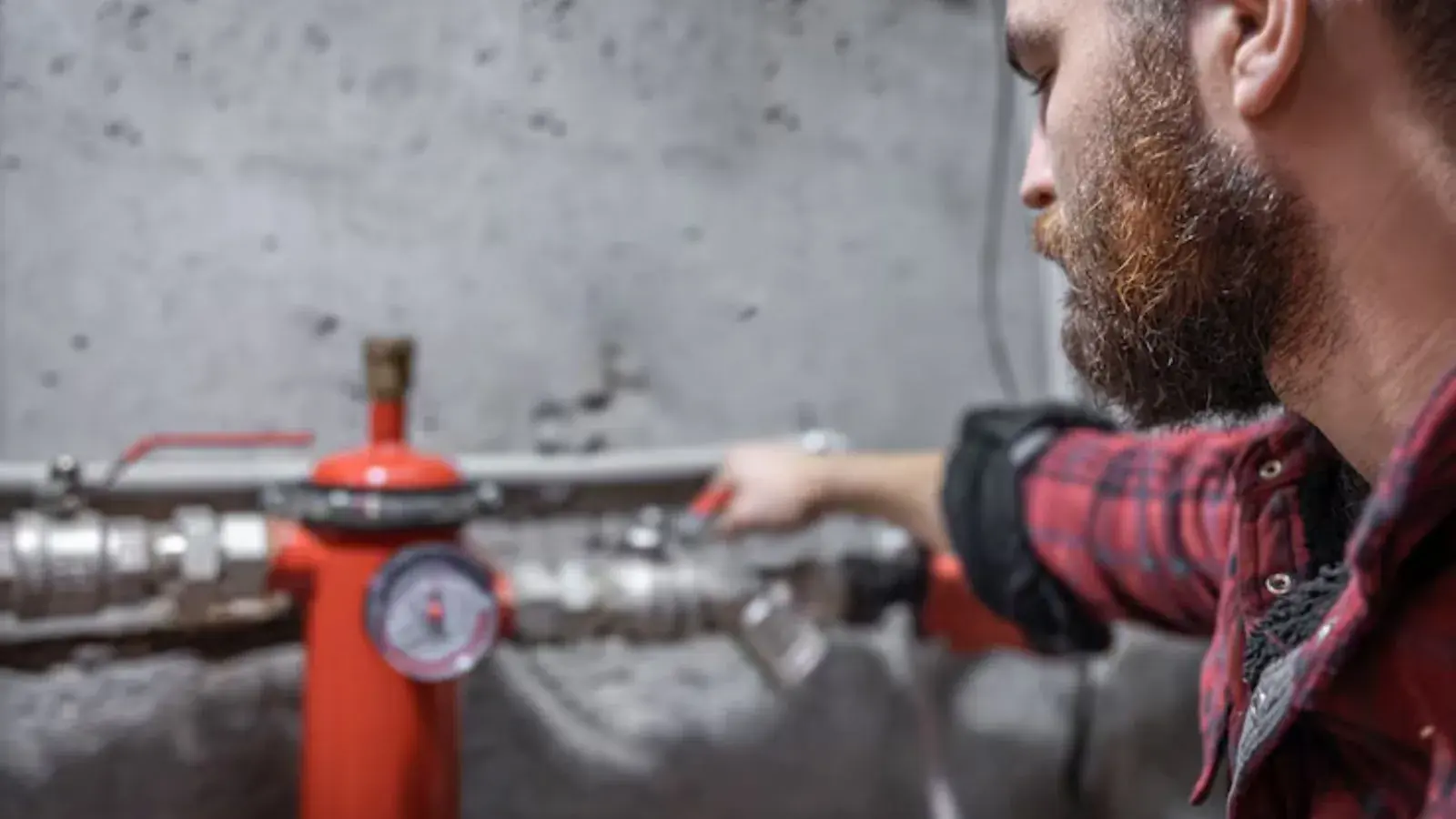
Water you cannot see is still water you pay for. If you are watching a meter spin, a ceiling stain spread, or a floor turn warm underfoot, call (855) 575-2890 and we are available 24/7 to send a technician. Same-day appointments are offered when the schedule allows, and we do not promise a set arrival time.
While you wait, shut off the main water valve if water is visibly pouring. Turn off power to any wet area before you touch anything, take photos of the damage and the meter, and move rugs and furniture off soaked flooring.
Water Is Actively Leaking Right Now
Find the main shutoff, usually where the line enters the house near the meter or the water heater, and turn it clockwise until it stops. If water is dripping near outlets or light fixtures, leave the breaker for that area off and stay out of the room.
- Photograph the meter dial and every damaged surface before cleanup starts
- Open a faucet at the lowest point of the house to drain the pipes once the main is closed
- Do not run the dishwasher, washer or water heater until the leak is found
- Keep a bucket and towels under active drips so the damage stays small
A Meter That Keeps Running or a Bill That Keeps Climbing
The water meter is the cheapest leak detector you own. The Village of Park Forest bills water per 1,000 gallons, according to its water page, so a leak shows up as use you cannot explain. A bill that climbs while your habits stay the same is the signal to run a test.
Turn everything off
Close every faucet, stop the dishwasher and washing machine, and ask everyone to hold off on flushing. Also check that no humidifier, ice maker or irrigation timer is drawing water.
Find the low-flow dial
Lift the meter lid. Most meters have a small triangle or star on the face, often called the low-flow indicator, that spins with even a thin trickle.
Watch it for a few minutes
If the dial moves with every fixture off, water is leaving the system somewhere between the meter and the fixtures.
Rule out the toilets
Add a few drops of food coloring to each tank and wait fifteen minutes without flushing. Color in the bowl means a worn flapper, the most common cheap cause of a running meter.
Record two readings
Write down the full reading, wait an hour or two with the water off, and read it again. Any change confirms a leak, and both numbers help us decide where to start.
If the dial sits still but the bill stays high, the leak may only run when a valve opens or pressure rises, such as an irrigation zone or a relief valve. A dripping relief valve on a tank is a water heater repair question, not a buried pipe.
How We Locate Water We Cannot See
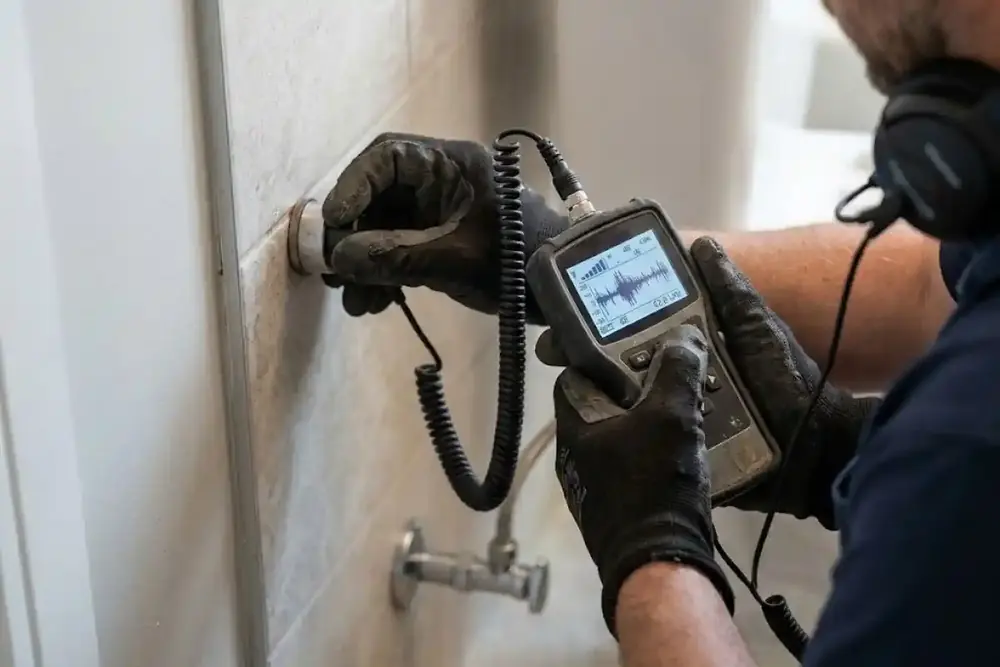
No single tool finds every leak, so we pick based on what the pipe is made of, where it runs and what the symptoms say. Most jobs use two or three methods to cross-check each other. The goal is a small, specific spot instead of a guess.
| Method | What it finds | Honest limit |
|---|---|---|
| Acoustic listening | The hiss or vibration of pressurized water escaping, using contact microphones on fixtures and ground microphones over slabs and yards | Traffic, plastic pipe and low pressure muffle the sound |
| Thermal imaging | Temperature differences from hot-water leaks, wet insulation and damp drywall | Shows temperature, not water, so cold-line leaks are subtle |
| Tracer gas | A harmless hydrogen and nitrogen mix pushed into an emptied line and sniffed at the surface | Needs the line isolated and drained, so setup takes time |
| Pressure testing | Whether an isolated section of pipe holds pressure on a gauge | Tells us a line leaks, not exactly where |
| Moisture meter | Dampness in drywall, wood and subfloor so a wet zone can be mapped | Condensation and old stains can give false readings |
| Line locator | The path of buried metal pipe, so listening is done directly above it | Plastic pipe needs a tracer wire or another approach |
These tools narrow the search, they do not X-ray a house. In some cases the last step is a small inspection opening in a wall or floor to confirm what the instruments suggest. We tell you that before we cut, not after.
Brown Rings on Ceilings, Soft Drywall and Bubbling Paint
Water rarely shows up where it starts. It runs along joists, pipes and framing, then soaks through the first surface that gives, so a stain in the hallway may trace back to a bathroom wall several feet away. A moisture meter lets us map the wet zone and work backward to the source.
Under a bathroom, the usual suspects are a supply fitting, a tub or shower drain connection, a pan that has cracked, or a toilet seal that has failed. Thermal imaging helps when a hot line is involved. If a stain only grows after rain, the cause may be a roof or gutter, and we will say so instead of billing you for a plumbing search.
Do not paint over a stain until the source is confirmed. Fresh paint hides the evidence, and trapped moisture breeds mold behind the wall. If the leak turns out to be a fitting that needs replacing, our plumbing installation crew handles the swap.
Leaks Under the House, in the Crawlspace or in the Basement
Exposed pipe is the easiest place to read a leak. Look for green crust on copper joints, rust streaks on galvanized steel, drip marks on the floor below a joint, and wet insulation. A dry tissue wrapped around a suspect pipe will show a slow weep within minutes.
A wet basement has more than one possible cause. The Village flooding page explains that heavy rain can overwhelm sewers and cause sewage backups in basements, so a floor that only gets wet after storms points away from a supply leak. A leak that continues in dry weather, with clean water, points toward a pipe. For storm-driven seepage, see basement waterproofing and sump pump service.
Slab Leaks Under Concrete Floors
A leak in a line under the slab gives off a few warnings. You may feel a warm spot on the floor, hear water running with every fixture off, see a meter that spins, or notice the water heater cycling more than usual. Low pressure at the faucets can come with it.
We locate slab leaks by isolating the hot and cold lines with a pressure test, then listening along the floor with a sensitive microphone and scanning for warm patches with a thermal camera. A line locator traces the pipe path so we know what is under each tile. That usually gets us to an area a couple of feet wide.
Repair choices include breaking the slab at the leak, rerouting the line through walls or the attic, or replacing the whole line through repiping. Each has trade-offs in mess, cost and how long the fix lasts, and we lay them out before work begins.
Water Service Line Leaks Between the Meter and the House
The service line is the buried pipe that carries water from the meter to your house. When it leaks, you may see a soggy strip of lawn in dry weather, hear a hiss near the entry point, notice pressure dropping, or watch the meter run with the house shut off. The ground around a leak can hide it completely, especially in clay soil.
We trace the line, listen over it, and pressure-test the section between the meter and the foundation. Ask the Village where its responsibility ends and yours begins before you plan any digging, and call 811 before anyone puts a shovel in the ground. Replacing a failed line is covered on our repiping page.
Sprinkler and Irrigation Leaks
Irrigation lines run under pressure only when a zone is on, which is why a sprinkler leak can hide from a standard meter test. A zone valve stuck partly open, a cracked head, a split lateral, or a weeping backflow preventer can each waste water without any visible puddle.
Turn the timer off and repeat the meter test. If the meter stops, run one zone at a time while watching the dial to see which one is leaking. In our cold winters, lines that were not drained before the first hard freeze can crack, so spring is a common time to find damage.
Pool, Spa, Yard and Meter-Box Leaks
Pool and spa leaks are a mix of structure and plumbing. We can test the supply and return lines and listen at fittings, but a cracked shell or a liner problem is a pool contractor's job, and we will tell you which side the problem is on.
A wet spot near the meter box or the curb stop may be a leak at the meter connection or a shutoff valve. Do not open the utility side yourself. Photograph it and call, and we will help work out whether the fix is on your side or the Village's.
Commercial Leak Detection
For shops, restaurants and offices, we find the leak using the same instruments and the same honesty about their limits. How a commercial job goes depends on access, because ceilings, mechanical rooms and shared walls decide what we can reach, and on scope, meaning if the leak needs locating, repairing or both. Our commercial plumbing team coordinates with managers who need the work done outside business hours.
What a Good Leak Report Should Tell You
When the search ends, you should know where the leak is, how confident we are, and what the repair choices are. If an instrument only narrowed the area, we say so. If we need to open a section of wall or floor to confirm, we explain why and keep the opening as small as we can.
Because Park Forest began as a planned community announced in 1946, plenty of houses here have decades of wear on their pipes. It helps to know your home's build year and what the supply lines are made of, since older galvanized or early copper lines tend to leak at fittings and corroded sections. Tell us what you know and we will plan around it.
What affects the cost of leak detection
Access to the pipe
A line in an open basement is quicker to test than one behind tile, cabinets or a finished ceiling.
How many methods we need
A simple meter and pressure test costs less time than a job that needs listening, thermal scanning and tracer gas together.
Pipe material and depth
Metal pipe can be traced with a line locator, while plastic and deep buried lines take more work.
Size and layout of the property
A small house with one bath is faster to isolate than a large home or a commercial space with many zones.
What happens after the leak is found
Locating is one task and repair is another, so a patch, a reroute or a repipe each carry separate costs.
Some homeowner policies address water damage, and some address detection costs, but coverage varies so ask your insurer what yours includes and keep your photos. Repairs that involve cutting into the slab or replacing lines may need a permit from the Village Building Department, which is required for homeowner and contractor work alike. Call us and we will explain the cost for your situation.
Get Your Real NumberQuestions we hear
Yes, dispatch runs 24/7, and we offer same-day appointments when the schedule allows. We do not promise an arrival time. Shut off the main valve, turn off power near wet areas, and take photos while you wait.
Run the meter test. With every fixture off, watch the low-flow dial for a few minutes. Movement means water is escaping. Other signs include warm floor spots, the sound of running water, damp drywall, musty smells and a bill that rises without a change in use.
Often we can narrow it to a small area using listening, thermal imaging and pressure testing, but these tools are not an X-ray. Some jobs need a small opening to confirm the source. We explain that first and keep the opening as small as we can.
No, it only shows how much water passed the meter. Park Forest bills per 1,000 gallons, so a jump suggests a leak, but it could be a toilet, a service line or a sprinkler zone. The meter test and our tools narrow it down.
Often, yes. A worn flapper or a chain that sticks is a common cause and the parts are simple. If the toilet still runs after a new flapper, or the base leaks, we can help with toilet repair.
It depends on access, pipe material and how many methods the job needs. A visible fixture leak can be found quickly, while a slab or buried line may take several steps. We tell you what to expect once we see the layout.
It depends on the repair. Park Forest requires a permit for plumbing work, done by you or by a contractor, and contractors must be Park Forest licensed. We tell you if your fix needs one.
Standards and sources
Written by the Park Forest Express Plumbing team. Plumbing work in Illinois follows the Illinois Plumbing Code, 77 Ill. Adm. Code 890, which the Village of Park Forest adopts. The Village Building Department states that contractors must be Park Forest licensed and that a permit is required. You can confirm any plumber's license on the Illinois Department of Public Health license verification tool.