Start with what the unit is doing
When a tankless heater stops making hot water, check the display, the flow, and the vent before anything else. Many faults trace to scale on the heat exchanger, a clogged inlet screen, a closed valve or a flow that is too low to fire the burner. A gas smell is different. Leave the house and call the gas utility or 911 first.
The unit's display is your best clue. Error codes differ by brand, so read the manual for the exact meaning, but they sort into a few families that point to a cause.
| Symptom | Likely cause | First check |
|---|---|---|
| No hot water, no display | Power, gas supply or tripped safety | Breaker, gas shutoff and error code |
| Hot water for a few seconds then cold | Low flow or a clogged screen | Fixture flow and inlet filter |
| Temperature swings | Scale on the heat exchanger or flow too low | Descale flush and aerator |
| Error code on ignition or flame | Venting or gas supply | Vent run and gas valve |
| Rumbling or popping sounds | Scale boiling in the exchanger | Flush with vinegar |
| Water leaks at the unit | Failed fitting or valve | Isolation valves and connections |
Reading error codes in general
A code is the heater's way of naming the circuit that failed, not the repair. Codes usually fall into ignition, flame sensing, overheating, flow, venting and sensor faults. Look up the number in your model's manual, write it down, and note what the unit was doing when it appeared.
Some codes clear after a power reset by switching off the breaker for a minute. If the same code returns, resetting again will not fix it, and a technician with the proper tools should test the part. We do not recommend opening the gas side of any unit without training.
The cold water sandwich and flow rate
The cold water sandwich happens when you shut a fixture off briefly and open it again. Hot water leaves, a slug of cold water follows, and then hot returns. The heater needs a few seconds to restart, and the cold water in the pipe passes through. It is common and not a defect, though a unit with scale or a weak sensor makes it worse.
Flow rate matters because most units need a minimum flow, often around half a gallon per minute, to light the burner. A low-flow shower head or a half-open valve can keep the unit from firing. Open the valves fully, clean the aerators, and test one fixture at a time.
Check the simple things first. Confirm that the shutoff valves on the hot and cold lines are fully open, that the gas valve is on, and that the inlet screen is not packed with sediment. Pull the screen, rinse it under a tap and put it back. Many no-heat calls end with that one step.
Rather have a plumber look at it?
Describe the problem on the phone and ask for a same-day appointment when one is available.
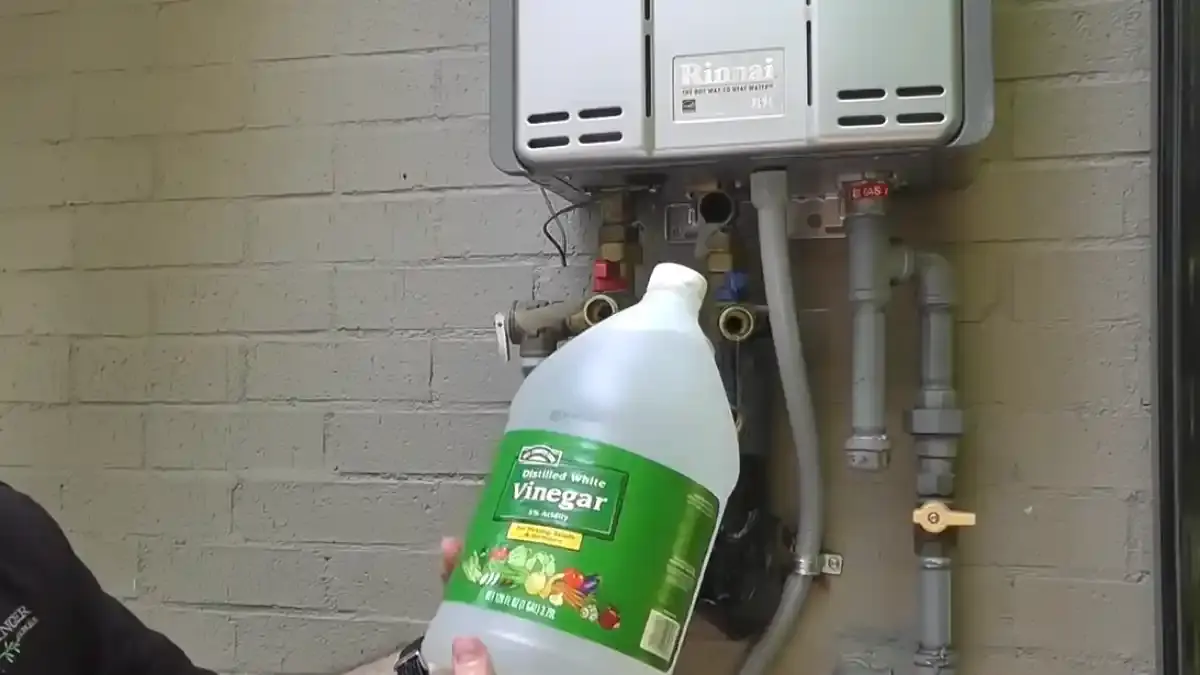
Flush a tankless heater with vinegar
Scale is the common cause of rumbling, uneven temperature and reduced flow. A flush dissolves the mineral buildup inside the heat exchanger. You need isolation valves, which are service valves on the hot and cold lines, a small pump, two hoses and about three to four gallons of white vinegar.
Shut off power, gas and water
Turn off the unit's power at the switch or breaker, close the gas valve and shut the cold water inlet. Let the heater cool if it was running.
Connect hoses and the pump
Attach hoses to the service ports on the hot and cold isolation valves. Run one hose from the pump to the cold side and the other back into a bucket of vinegar.
Circulate the vinegar
Open the service ports and run the pump for about 45 to 60 minutes. The vinegar picks up scale as it circulates. Cloudy liquid means the buildup is coming off.
Flush with clean water
Drain the vinegar, then rinse the unit with fresh water for several minutes. Clean the inlet screen filter, close the service ports, and restore power, gas and water.
Practical tip
If the unit has no isolation valves, a plumber can add them. They cost little and make every future flush a 20-minute job instead of a full disassembly. Put a date on the heater so you remember when you last flushed it.
Water quality also decides how often you flush. Hard water leaves scale on the heat exchanger within months, while soft or treated water takes longer. A yearly flush is a good starting point, and you can shorten the interval if the flush water comes out cloudy or you hear popping at startup.
Venting, combustion air and when to call
Blocked or damaged venting stops a tankless heater faster than any other cause, because the unit shuts down to protect itself. Check outside for a cracked cap, a bird nest, snow or ice, and loose joints. Do not seal or alter the vent pipe, and do not run a unit with signs of soot or a burning smell.
Call a professional if a code returns after a reset, if the unit leaks, or if you see scorching on the case. Our tankless water heater service covers installs, descaling and diagnostics, and water heater repair covers the failed parts. We cannot diagnose a heat exchanger without testing it on site.
Park Forest note: village water and your heater
The Village of Park Forest pumps groundwater from six wells about 300 feet deep into a dolomite limestone aquifer. The plant softens the water with a lime and soda ash process, filters it, adds chlorine, fluoride and orthophosphate for corrosion control. The Village page does not publish a hardness number, so we cannot say how fast scale will form in your unit. Softening at the plant can slow buildup, but it does not remove it, so a periodic vinegar flush is still sensible.
For water quality questions, call Public Works at 708-503-7702 for test summaries, or Village Hall at 708-748-1112. Water Department hours extend to 8 pm on Mondays. A water heater replacement is listed under traditional permits at the Building Department, so ask before you swap a unit. If you are comparing homes in Olympia Fields or University Park, note that University Park gets water from Aqua Illinois, a private utility, so ask who serves your address.
Questions we hear
Low flow, a clogged inlet screen or scale can interrupt the burner. Clean the screen, open the valves fully and test other fixtures. If it persists, have the unit checked for a failing flow sensor.
Once a year is a common recommendation, and more often in areas with hard water. Follow the maker's manual, since the interval depends on the model and your water.
Often yes. Switch off the breaker for a minute and turn it back on. If the same error returns, stop resetting and call a technician.
A short burst of cold water between two bursts of hot. It happens because the heater restarts after a pause. Using a steady flow instead of tapping the fixture on and off helps.
No. The Village softens water at the plant with a lime and soda ash process, which can slow scale, but it does not eliminate it. The Village page publishes no hardness number, so a periodic flush with isolation valves is the safe approach.
No. The Village softens water at the plant with a lime and soda ash process, which can slow scale, but it does not eliminate it. The Village page publishes no hardness number, so a periodic flush with isolation valves is the safe approach.
Standards and sources
Written by the Park Forest Express Plumbing team. Plumbing work in Illinois follows the Illinois Plumbing Code, 77 Ill. Adm. Code 890, which the Village of Park Forest adopts. Local statements on this page come from Village of Park Forest pages, and the Building Department states that a permit is required whether you or a contractor does the work. Before you hire anyone, check the license on the Illinois Department of Public Health license verification tool.