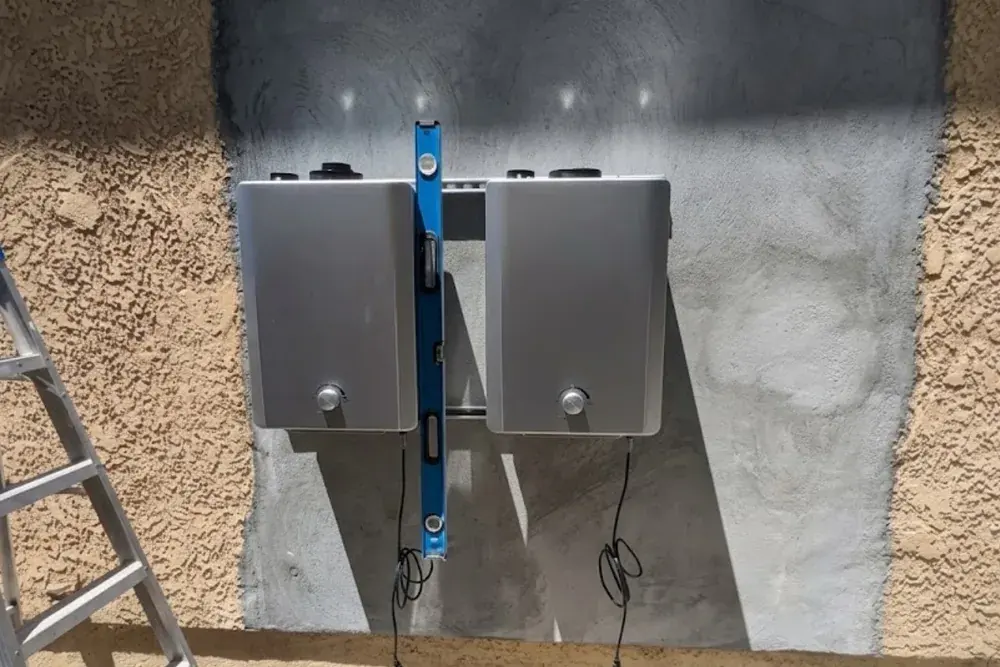
Instead of storing hot water, a tankless heater heats it as it flows through a heat exchanger. That is why it can deliver hot water for as long as the flow lasts, and also why it is more sensitive to scale, gas supply and venting than a tank.
Flush and descale, the service that keeps tankless units alive
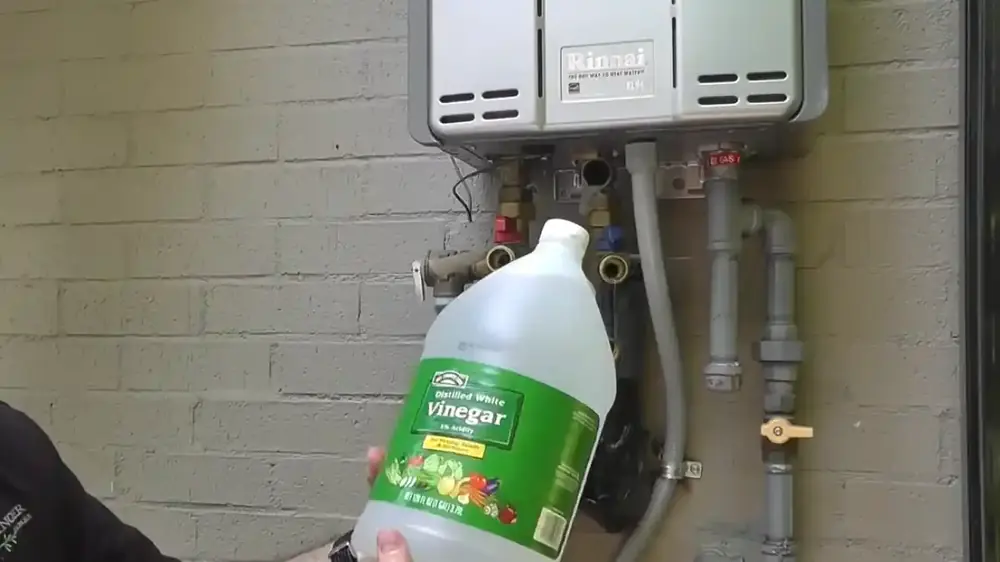
Minerals in water build up inside the heat exchanger, narrow the passages and make the unit work harder. Descaling means circulating a mild descaling solution, usually white vinegar or a manufacturer-approved cleaner, through the unit with a small pump and hoses connected to the service valves. We then flush it with clean water.
Signs a unit is overdue include lukewarm output, a rise in error codes, rumbling or kettling noises, and falling flow. We also clean the inlet screen, check the condensate trap on condensing models and confirm the gas pressure.
Isolation valves make it easy
Tankless units should have service valves so a descaling pump can connect without cutting pipes. If yours has none, we can add them during a visit. Many manufacturers tie warranty coverage to regular descaling, so check your paperwork.
Park Forest water comes from groundwater that the Village softens at the plant, and orthophosphate is added for corrosion control. That reduces some mineral loading but does not remove it, so a periodic flush still makes sense, and a home with its own softener or filter should still schedule one.
Sizing by flow rate and temperature rise
Two numbers decide whether a tankless unit fits your home. The first is flow rate, how many gallons per minute you need when several fixtures run at once. The second is temperature rise, the difference between cold incoming water and your target hot temperature.
Winter inlet water is much colder than summer water in northern Illinois, so a unit that handles two showers in July may struggle in January. We size for the coldest conditions, add up the fixtures that run at the same time, such as a shower, dishwasher and laundry, and match that to the unit's rated output.
Gas line and vent upgrades
A gas tankless heater burns a lot of fuel in a short burst, so the gas line often has to be larger than the one that fed your old tank. The vent must be rated for the unit, sealed correctly and routed to the outdoors. Condensing models use plastic vent pipe and need a condensate drain.
If you smell gas at any time, leave the home and call the gas utility or 911 from outside. Electric tankless units skip the gas and vent but need a very large dedicated circuit that some panels cannot supply.
Honest pros and cons
| Point | Tankless | Tank |
|---|---|---|
| Hot water supply | Continues while flow lasts, limited by flow rate | Limited by tank size, then slow recovery |
| Space | Wall-mounted and compact | Takes floor space |
| Standby heat loss | Little to none | Constant |
| Install work | Gas, vent or electrical upgrades common | Usually a simple swap |
| Maintenance | Regular descaling needed | Flushing and anode checks |
| Lifespan | Often longer when maintained | Often shorter |
| Minimum flow | Very low flow may not fire the burner | Not an issue |
A tankless unit is not always better. If you have low flow fixtures, a tight gas supply or an older home with limited venting options, the extra work may not pay off. We tell you straight when a tank fits better, and our water heater installation page covers both paths.
Tankless repair and error codes
Error codes point to a category of fault, not a single part. Common categories are ignition failure, flame loss, overheating, blocked vent or exhaust, inlet or outlet sensor problems, and condensate or flow issues. The manual tells you what a code means for your model, and we confirm the cause on site.
Ignition or flame loss
Often low gas pressure, an air problem, a dirty igniter or a flame rod needing cleaning.
Overheat or high limit
Scale in the heat exchanger or a flow restriction can cause overheating.
Vent or exhaust fault
A blocked, loose or undersized vent. This is also a safety issue.
Cold water sandwich
A burst of cold between hot water uses, often tied to flow, sensors or scale.
If the unit has shut down or you have no hot water, see our water heater repair page for what to check, or call us and we will triage by phone.
Tankless unit shut down or throwing an error
Turn off the unit, check that the gas valve and water valves are open, and look at the code on the display. A reset sometimes clears a one-time fault, but a code that keeps returning means something real needs attention. Do not keep resetting a unit that smells of gas or shows exhaust trouble, and leave the home for any gas odor.
What affects the cost of tankless work
Unit size and brand
Higher output and condensing models cost more and take more labor.
Gas line and venting
New piping, a new vent run and a condensate drain add scope.
Service valves and water treatment
Isolation valves and a scale filter are common add-ons.
Electrical needs
Electric units may need panel work by a licensed electrician.
Permit
Replacing a water heater is a Village of Park Forest permit item.
Insurance usually does not cover planned upgrades or wear, though it may respond to sudden water damage. Contractors working in the Village must be Park Forest licensed, and we explain permit steps before work starts. Call us and we will give you a real number after we look at your gas, vent and flow needs.
Get Your Real NumberQuestions we hear
It depends on how much mineral is in your water and how much you use the unit. Many manufacturers suggest yearly service, and heavy use or hard water may call for more. Follow your manual, and note that it may affect warranty.
Some homeowners do, but it needs service valves, a small pump and hoses, and care with the solution and gas. If the valves are missing, a plumber should add them. A bad connection can leak or damage the unit.
Often not without changes. Tankless units draw much more fuel at once than a tank, so the line size, length and meter capacity have to be checked. We measure the run and confirm the supply before recommending a model.
The unit may shut off briefly between uses or flow may be too low to fire it. Scale, sensor faults or bad plumbing can also play a part. We check flow, scale, sensors and recirculation settings.
Each maker has its own list, but most fall into ignition, flame, overheating, vent or sensor categories. The display code plus a site check identifies the real cause. Repeated codes need a technician rather than another reset.
It can be, if the unit is sized for the coldest incoming water and you have the gas supply and vent. Winters in the Chicago south suburbs are cold, so the temperature rise matters more here. We size for winter conditions.
Safety steps for a tankless water heater
If you smell gas, leave the building and call the gas utility or 911. Do not try to repair a gas valve, burner or vent pipe yourself.
Before any maintenance, switch off the power and close the water and gas shutoffs. Flushing out scale is a job for someone who knows the unit, because a vent or gas connection put back wrong is a hazard.
Standards and sources
Written by the Park Forest Express Plumbing team. Plumbing work in Illinois follows the Illinois Plumbing Code, 77 Ill. Adm. Code 890, which the Village of Park Forest adopts. The Village Building Department states that contractors must be Park Forest licensed and that a permit is required. You can confirm any plumber's license on the Illinois Department of Public Health license verification tool.