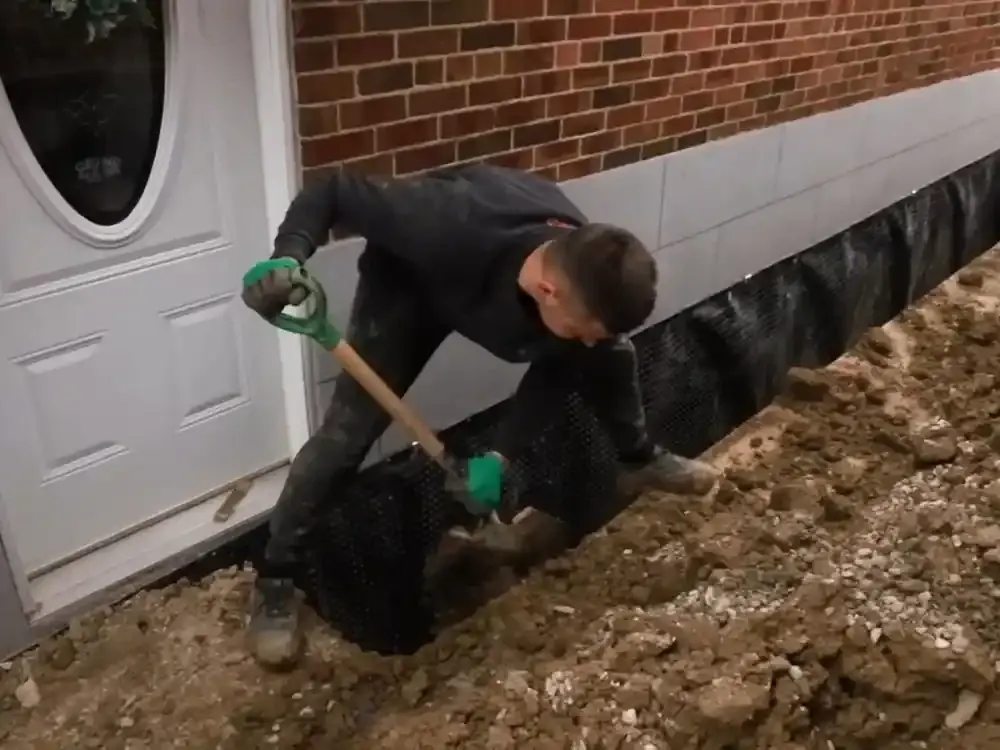
You can fix a surprising amount of basement water yourself. Clean gutters, downspout extensions, better grading, sealed window wells, and small crack repairs handle the most common causes at a low cost. What a homeowner cannot fix is water pushing up through the floor or through a wall under pressure, and that takes drainage work or a pump.
Start with the cheap outdoor fixes and watch what happens during the next hard rain. If the basement stays dry, you are done. If not, you have learned where the water enters, which helps when you talk to a pro about basement waterproofing.
Start by finding the real source
Tape a one-foot square of plastic sheeting to a damp wall or floor spot, sealing all four edges with duct tape. Leave it for a day or two. Moisture under the plastic means water is coming through the concrete, while moisture on the outside surface means indoor humidity is condensing.
Next, look at the pattern. Water at the base of a wall, along the floor joint, points to groundwater pressure. Streaks below a window point to the window well. A stain under a pipe or the water heater is a plumbing leak, and no sealant will fix it.
Gutters, downspouts, and grading come first
A roof sheds a lot of water in a storm, and a half-inch of rain on a 1,500 square foot roof produces hundreds of gallons. If the gutters are clogged or the downspouts empty beside the foundation, that water goes straight into the soil next to your basement wall. Clean the gutters in spring and fall, and fix any sagging or leaking sections.
Extend each downspout several feet from the house using a solid pipe or a hinged extender. Then check the ground around the foundation. It should slope away from the wall, about six inches of drop over the first ten feet, and any low spot that holds water after rain should be filled with compacted clay-rich soil, not mulch or loose topsoil.
Practical tip: watch the yard during a storm
Put on a rain jacket during the next heavy downpour and look at where the water travels. Puddles beside the foundation, downspouts that overflow, and flow running toward the house tell you more than any guess. Take photos so you can show them to a contractor.
Window wells and small cracks
Window wells fill with leaves and dirt, and then water backs up against the glass. Clear the debris, add a few inches of gravel at the bottom, and fit a clear cover that sheds rain. If the well has a drain at the bottom, pour a bucket of water in and confirm it empties.
Hairline cracks in a poured concrete wall can be sealed from inside with hydraulic cement or an injected polyurethane or epoxy kit. They are cheap and effective for narrow, stable cracks. They are not a fix for wide cracks, cracks that keep growing, or cracks with a horizontal line, which can mean the wall is moving.
Be skeptical of paint-on waterproofers. They hold back damp air, not water pressure, and they often peel off within a season or two if water keeps pushing through the wall.
| Problem | DIY fix | When to call a pro |
|---|---|---|
| Clogged or short downspouts | Clean gutters, add extensions | Roof drainage is too large for the gutters to carry |
| Soil slopes toward the house | Add and compact fill, regrade | Large areas of yard, or paving that traps water |
| Window well leaks | Clear debris, add gravel and a cover | The well wall is cracked or the well sits below a drain tile |
| Narrow wall crack | Hydraulic cement or injection kit | The crack is horizontal, stair-stepped, or wider than a pencil |
| Water along the floor joint | Humidity control and outdoor fixes first | It returns after rain, which suggests an interior drain and sump are needed |
| Standing water in the pit | Test the float and clear the pit | The pump is older, noisy, or cannot keep up, so see sump pump service |
Rather have a plumber look at it?
Describe the problem on the phone and ask for a same-day appointment when one is available.
Where DIY stops
Water coming up through the floor slab or the joint between wall and floor is groundwater pressure, and surface fixes do not change it. The common professional answer is an interior drain, a perimeter drain tile with a sump pit, and a pump to push the water out. That job requires cutting the floor, and it is not a weekend project for most homeowners.
A wall that bows inward, a horizontal crack across a block wall, or stair-step cracks in the mortar are structural problems. A plumber or waterproofing contractor can describe the water side of the fix, but a structural engineer should look at the wall itself. Do not seal a moving wall and hope it holds.
If a drain or sewer line is backing up into a floor drain, that is a different problem and not groundwater. A wet corner in a home in Olympia Fields or Chicago Heights can turn out to be a drain problem too, so find out which before you spend money on sealers.
Keep the basement dry between storms
- Run a dehumidifier in summer to hold humidity below about 50 percent.
- Keep storage a few inches off the floor on plastic shelves.
- Look at the sump pit twice a year and pour in water to test the float.
- Leave the discharge line clear of leaves, ice, and snow piles.
- Check the water heater and washer hoses for slow drips that look like seepage.
These habits cost little and catch small problems before they become damaged drywall or stained carpet. Mold can start growing on damp materials within a day or two, so remove wet items quickly after a storm.
Park Forest programs that help keep water out
The Village of Park Forest says urban flooding happens when rain falls faster than the soil can take it in, and the sewers cannot handle the runoff. That is why the Village promotes simple yard fixes. Its programs include downspout extensions, rain barrels, a rain garden incentive, and permeable pavement, all of which keep roof and driveway runoff from reaching your foundation.
The park system was designed as reservoirs for stormwater, and Central Park was restored as a wetland, so the Village treats yards and parks as part of the drainage plan. The Village also offers a Flood Factor map where you can check an address. It is a modeled estimate, not a Village measurement, but it can help you decide how seriously to take a soft spot in your yard. For sewage backups, remember that the Village is replacing its own wastewater lines, so a backup at your home may still be on your private side and worth a camera look.
Questions we hear
Usually not for long. Paint can slow damp air or light moisture, but it cannot hold back water pressure from outside the wall. If water is entering through the concrete, the paint will blister and peel. Fix the outdoor drainage first, then judge what is left.
Tape a square of plastic sheeting to the wall or floor and seal the edges. After a day or two, moisture on the room side of the plastic is condensation from humid air. Moisture trapped behind the plastic means water is coming through the concrete.
Narrow, stable vertical cracks in poured concrete can be sealed with an injection kit or hydraulic cement. Wide cracks, horizontal cracks, or cracks that keep growing may signal wall movement and should be checked by a professional before any sealing.
If water collects at the floor joint after most heavy rains even after the outdoor fixes, a perimeter drain and sump pump are the usual answer. A pump gives the water somewhere to go. Our sump pump installation and repair page explains what a plumber installs.
The Village flooding page lists a rain garden incentive, downspout extensions, rain barrels, and permeable pavement as ways to keep runoff on your lot. It also links a Flood Factor map to check an address, which is a modeled estimate rather than a Village measurement. Call Village Hall for current program details.
The Village flooding page lists a rain garden incentive, downspout extensions, rain barrels, and permeable pavement as ways to keep runoff on your lot. It also links a Flood Factor map to check an address, which is a modeled estimate rather than a Village measurement. Call Village Hall for current program details.
Standards and sources
Written by the Park Forest Express Plumbing team. Plumbing work in Illinois follows the Illinois Plumbing Code, 77 Ill. Adm. Code 890, which the Village of Park Forest adopts. Local statements on this page come from Village of Park Forest pages, and the Building Department states that a permit is required whether you or a contractor does the work. Before you hire anyone, check the license on the Illinois Department of Public Health license verification tool.