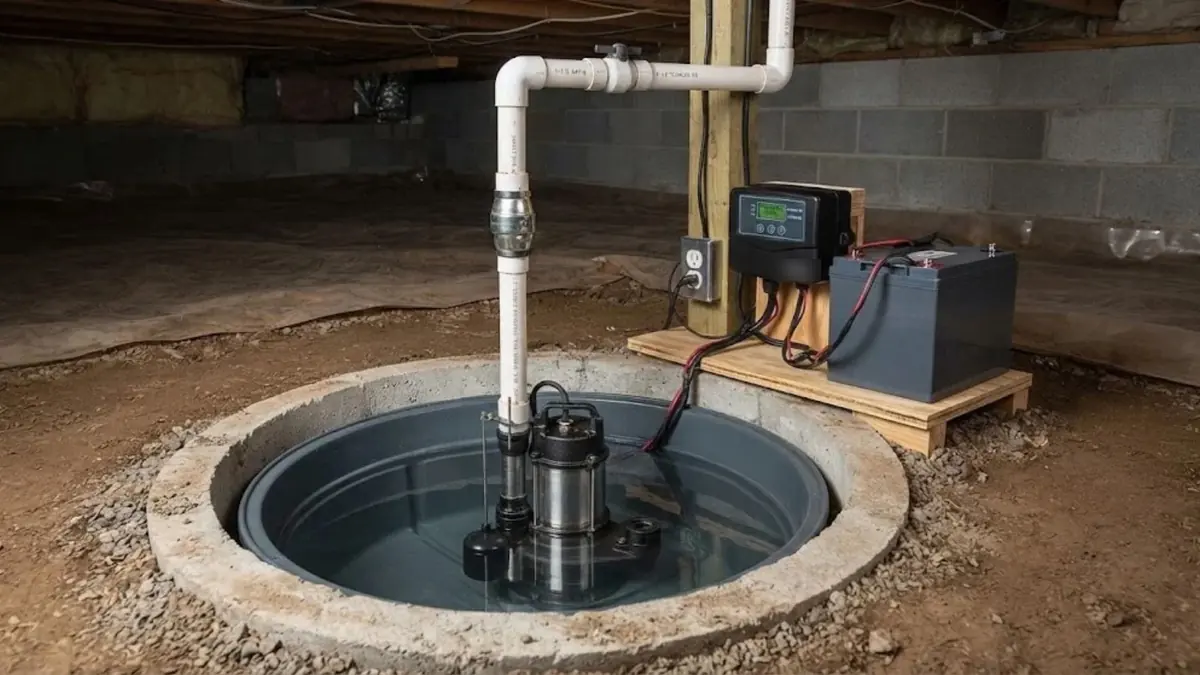
A sump pump install has six parts. You break the slab and dig a pit, set a basin, drop in the pump, add a check valve, run a discharge pipe outside, and power it from a GFCI outlet. A confident DIYer can replace a pump in an existing pit in an afternoon. Cutting a brand new pit through a concrete floor is a bigger job, and that is where most people call a plumber.
This guide walks through each step in order so you can decide how much to take on. If you want help with the pump itself, our sump pump installation and repair service covers both new pits and swaps.
Before you pick up a tool
Find out where the water actually enters the basement. A sump pump only helps if groundwater collects at one low point, usually along the wall and floor joint. If water comes through a crack high on the wall, a pump will not fix it, and you may be looking at a basement waterproofing problem instead.
Pick the spot with the most water, ideally near an outside wall and close to an outlet. Check that the discharge pipe can reach the outdoors by a short, downhill run. A pit in the far corner with a forty-foot pipe run is a poor plan.
Digging the pit and setting the basin
Most basins are plastic or fiberglass, about 18 inches wide and 22 to 30 inches deep. You mark a circle slightly wider than the basin and cut the slab with a concrete saw or an electric demolition hammer. Concrete dust is hazardous, so wear a respirator, eye protection, and hearing protection.
Dig out the soil below the slab until the basin sits with its rim flush with the floor. Many installers spread a few inches of washed gravel in the bottom so water can drain in from all sides. Set the basin level, backfill around it with gravel, and patch the slab around the rim with concrete.
Do not skip the lid. A sealed lid keeps out debris, children, and basement humidity, and it prevents radon or sewer-like odors from rising through the pit.
Pump, check valve, and discharge line
Submersible pumps sit inside the basin and are the usual choice for homes. Pedestal pumps keep the motor above the pit, which makes them cheaper and noisier, and they tend to wear out sooner. Either type has a float switch that turns the motor on when the water rises.
Thread a short length of pipe onto the pump outlet, usually 1.5 inches, and then install a check valve. The check valve is a one-way flap that stops pumped water from draining back into the pit when the motor shuts off. Without it, the pump cycles on and off constantly and wears out early.
Drill a small weep hole, about an eighth of an inch, in the pipe just above the pump and below the check valve. It releases trapped air so the pump does not airlock and sit running without moving water. Then run the pipe up and out through the rim joist, glued with PVC cement at every joint.
Practical tip: test with a bucket
Once everything is connected, pour five gallons of water into the pit slowly. Watch the float rise, hear the motor start, and confirm water leaves through the discharge outlet outside. Fix any drips at the fittings before you close the lid and walk away.
Rather have a plumber look at it?
Describe the problem on the phone and ask for a same-day appointment when one is available.
Where the water goes outside
Discharge water should leave the house and soak into the ground away from the foundation, not run back toward it. Many guides suggest ending the pipe at least ten feet from the wall, on ground that slopes away. A short splash block is not enough, because the same water will cycle back into the pit.
Do not connect the sump line to the sanitary sewer or to a floor drain that leads there. Clean groundwater in a sewer line overloads the system and is generally prohibited, so ask the Village before you plan any connection. If the discharge could freeze in winter, add a pop-up emitter at the end so water has a second path out when the pipe ices over.
Power, GFCI, and a backup that works in a storm
The pump should plug into a GFCI-protected outlet, ideally on its own circuit so a toaster or dehumidifier cannot trip it. Heavy rain often comes with power outages, and a pump without power does nothing. A battery backup pump, or a water-powered backup if your municipal water pressure is steady, covers that gap.
Pick a backup that runs on its own float switch, mounted a few inches higher than the main pump. Test it twice a year. Batteries last a few years and then lose capacity, so treat them as a part to replace on a schedule.
| Job | DIY is realistic if | Call a plumber if |
|---|---|---|
| Swap a pump in an existing pit | The pit and pipe are in good shape and you can shut off power safely | The pipe is corroded or the check valve is hard to reach |
| Add a battery backup pump | You have room in the pit and a spare outlet | The wiring needs a new circuit or GFCI outlet |
| Cut a new pit in the slab | You have concrete saw experience and a way to haul out debris | The floor is thick, reinforced, or near a drain or gas line |
| Run a new discharge line | The route is short, downhill, and above ground | It must cross a yard, go below grade, or tie into storm drainage |
| Pull a permit or deal with inspections | You are comfortable with the paperwork | You would rather have a licensed contractor handle it |
When a professional is the better call
Cutting through a slab is the step where most DIY jobs go wrong. Hitting a drain line, a radon pipe, or a stretch of thick reinforced concrete turns a one-day job into a mess. A plumber arrives with a saw, a vacuum, and a plan for the debris.
The wiring and the check valve are the other common trouble spots. A pump wired to an ungrounded outlet is a shock risk in a wet basement, and a check valve installed backward or left out wears the pump quickly. If your basement floods when the pump fails, a second opinion on the whole setup is cheap insurance.
If you live in a neighboring town such as Richton Park or Matteson, the same steps apply to pits, pumps, and discharge lines. Local permit rules differ by village, so check with yours first.
What Park Forest says about flooding and permits
The Village of Park Forest explains that urban flooding happens when rain falls faster than the ground can absorb it and the sewers cannot carry the runoff. That is why a sump pump should discharge to a yard or splash area and never into a sewer line, because storm flow already strains the system. The Village is also replacing its own wastewater lines, and its park system was designed as reservoirs for stormwater.
The Building Department at 350 Victory Drive says that a permit is required if you do the work yourself and also if you hire a contractor. A homeowner doing their own work submits a waiver form, and a contractor working in Park Forest must be Park Forest licensed. Permits are not taken by email or online, so plan to drop off or mail the paperwork, and ask them whether a sump pump installation needs one. The Village also adopts the Illinois State Plumbing Code.
Questions we hear
Most pumps last several years and then need replacing, depending on how often they run and the water quality. A pump that cycles constantly, makes grinding noise, or runs without moving water is near the end. Test yours a couple of times a year by pouring water into the pit.
Yes, in almost every setup. The check valve keeps pumped water from flowing back into the pit when the motor stops, which would make the pump restart over and over. Install it above the pump, after a short run of pipe, and keep it accessible so it can be replaced.
Generally no. Clean groundwater should not go into a sanitary sewer, because it overloads the system during storms and is usually prohibited by local rules. Send it outside, away from the foundation, and ask your Village which discharge options are allowed.
If your basement can take on water during a storm, a backup is worth having. Heavy rain often brings outages, and the main pump stops with no power. A battery backup with its own float switch runs for a limited time, so treat it as a bridge until power returns.
The Village Building Department says a permit is required for homeowners doing the work and for hired contractors, and homeowners doing their own work submit a waiver form. Call the department at Village Hall, 350 Victory Drive, to confirm whether a sump pump is covered. Permits are dropped off or mailed, not handled by email or online.
The Village Building Department says a permit is required for homeowners doing the work and for hired contractors, and homeowners doing their own work submit a waiver form. Call the department at Village Hall, 350 Victory Drive, to confirm whether a sump pump is covered. Permits are dropped off or mailed, not handled by email or online.
Standards and sources
Written by the Park Forest Express Plumbing team. Plumbing work in Illinois follows the Illinois Plumbing Code, 77 Ill. Adm. Code 890, which the Village of Park Forest adopts. Local statements on this page come from Village of Park Forest pages, and the Building Department states that a permit is required whether you or a contractor does the work. Before you hire anyone, check the license on the Illinois Department of Public Health license verification tool.