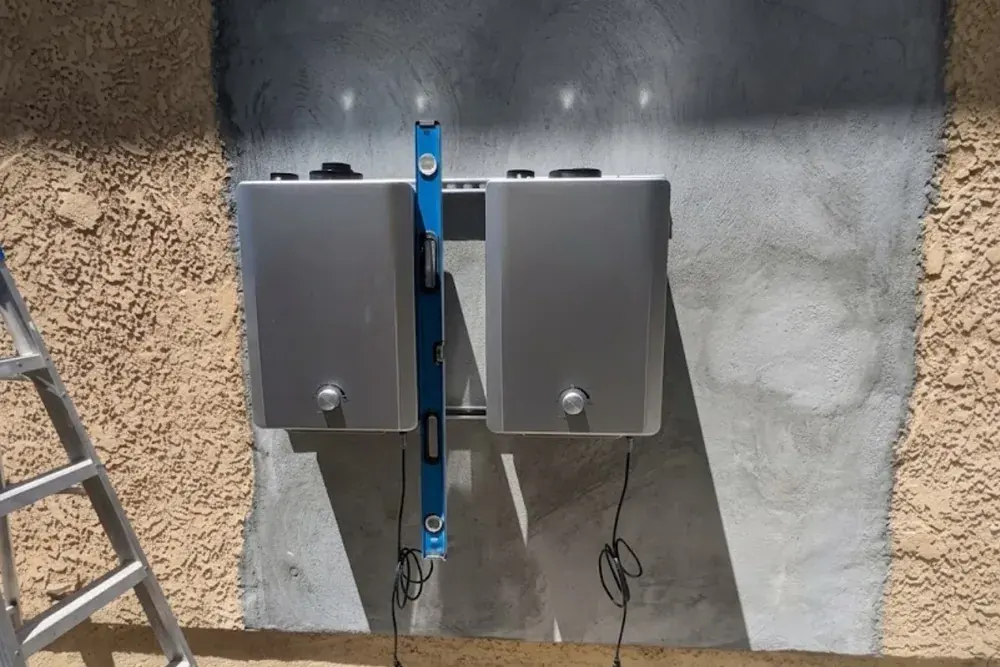
A tankless water heater is sized by peak hot water flow, measured in gallons per minute (gpm), and by temperature rise. Rise is the gap between the water entering the house and the temperature you want at the tap. Add up the fixtures that really run together, then match that total to a heater's rated flow at your rise.
Most households land between 4 and 10 gpm at their busiest moment. A small home with one bathroom sits near the bottom of that span, and a family with several showers can reach the top. The rest of this guide shows how to get your own number.
Step one is counting the fixtures that overlap
Total daily use does not matter for a tankless unit. What matters is the busiest few minutes, such as two showers running while the dishwasher fills. Think of a normal weekday morning and write down every hot tap that is open at once.
| Fixture | Typical flow, gpm | Notes |
|---|---|---|
| Bathroom sink faucet | 0.5 to 1.5 | Aerators lower the flow |
| Kitchen sink faucet | 1.5 to 2.2 | Higher if the aerator is removed |
| Showerhead | 1.5 to 2.5 | Federal limit for new heads is 2.5 gpm |
| Dishwasher | 1.0 to 2.0 | Draws hot water only while filling |
| Clothes washer | 1.5 to 3.0 | Depends on the wash cycle selected |
| Bathtub fill | 4.0 to 6.0 | Rare to run with other fixtures |
The label on your showerhead or the box it came in usually states its flow. If you have an older showerhead with no markings, a bucket and a timer will give a rough reading. Measure the hot side only, since a mixed tap at half hot uses half as much heated water.
Temperature rise is the number people forget
A tankless heater can only add so many degrees at a given flow. If the incoming water is 50 degrees and you want 120 at the tap, the heater must add 70. The colder the supply, the lower the flow it can deliver at full temperature.
Winter is the season that sets the size. Cold weather chills the pipes and the ground around the service line, so a unit that keeps up in July can fall short in January. Size for the coldest months, and ask your installer to measure the incoming water temperature rather than guess.
Many people set storage heaters near 120 degrees. That figure is a common target for sizing and it also limits scald risk, especially around children and older adults.
A worked example, with illustrative numbers
The figures below are made up to show the method. They are not measurements of any Park Forest home. Suppose a household wants two showers and a kitchen faucet running together on a cold morning, with 45 degree incoming water and a 120 degree target.
| Step | Value | How it is found |
|---|---|---|
| Two showers | 2.0 gpm each, 4.0 gpm | Typical hot flow per shower |
| Kitchen faucet | 1.5 gpm | Typical hot flow |
| Peak demand | 5.5 gpm | Add the flows |
| Temperature rise | 75 degrees | 120 minus 45 |
| Heat needed | about 206,000 BTU per hour | 5.5 gpm x 500 x 75 rise |
| Gas input needed | about 217,000 BTU per hour | Output divided by roughly 0.95 efficiency |
The 500 in that formula comes from water weighing about 8.3 pounds per gallon and 60 minutes in an hour. The result lands above the input rating of most single residential gas units. That tells the household to either accept a lower flow in winter, stagger the showers, or consider two units.
Ask for the rated flow at your rise
Manufacturers list gpm at several temperature rises. A heater advertised as 9 gpm may deliver that only at a 40 degree rise. Compare the number at your own rise, not the headline figure on the box.
Rather have a plumber look at it?
Describe the problem on the phone and ask for a same-day appointment when one is available.
Gas or electric, and why it changes the answer
Gas units move far more heat than electric ones, which is why they handle whole-house loads in cold climates. Electric models can be a fit for a small apartment or a single remote bathroom. The table shows the tradeoffs in plain terms.
| Factor | Gas | Electric |
|---|---|---|
| Heat output | High, often 150,000 to 199,000 BTU per hour input | Limited by the panel and wiring |
| Whole-house use | Common choice | Rarely practical in a cold climate |
| Venting | Sealed vent through a wall or roof, plus a condensate drain on condensing models | No combustion vent |
| Main upgrade | Larger gas line | Large breaker and heavy wiring |
| Example load | 5.5 gpm at 75 rise needs about 217,000 BTU per hour | The same load needs roughly 60 kilowatts |
That 60 kilowatt figure comes from dividing 206,000 BTU per hour by 3,412, the BTU in one kilowatt-hour. It would call for an electrical service most houses simply do not have. For a family home, gas is usually the realistic path, and small electric units are better for a single sink or shower.
The gas line is part of the sizing job
A storage heater draws roughly 30,000 to 50,000 BTU per hour. A tankless unit can pull four times that, and your furnace and range pull gas at the same moment. The existing half-inch branch that fed the old tank is often too small for the run.
Line size depends on pipe diameter, the length of the run, and the total load on the line. The installer adds up every appliance and checks the pipe against the manufacturer's tables and the Illinois State Plumbing Code. Sometimes the answer is a larger branch line, and sometimes the meter or regulator needs attention from the gas utility.
Venting matters as much as gas. Condensing units usually vent in plastic pipe and need a place to drain acidic condensate, while non-condensing units need stainless venting. If you ever smell gas, leave the house and call the gas utility or 911 first. Do not turn switches or look for the leak yourself.
What to settle before the heater is chosen
- Peak flow from your own list of overlapping fixtures, in gpm.
- Winter incoming water temperature, measured and not assumed.
- Fuel type, with gas line size and venting route confirmed on site.
- Condensate drain location and a floor drain or pump if needed.
- Whether installers will pull the permit and handle the final inspection.
Our tankless water heater page covers how installation is handled, and the water heater installation page explains the swap from a tank. Call (855) 575-2890 if you want a technician to check your gas line and fixture list before you pick a model.
Park Forest note: the water and the permit
The Village of Park Forest supplies your water from six wells about 300 feet deep. At the plant it is softened with a lime and soda ash process, filtered, disinfected with chlorine, and treated with orthophosphate for corrosion control. Softened water is usually kinder to heater internals, but the Village publishes no hardness number on its water page, so call Public Works at 708-503-7702 and ask for the test summaries before deciding on scale protection.
Water heater replacement is listed among the traditional permits at the Village Building Department, 350 Victory Drive. A permit is needed when you do the work yourself or hire it out, and contractors working in the village must be Park Forest licensed. Permits are dropped off or mailed, not taken by email or online, so build that into your timeline. If you live just across the line, the same sizing steps apply in Richton Park, where the Village pumps from wells 400 to 800 feet down, and in Matteson, where you should ask the Village which supplier serves your address.
Questions we hear
Many households fall between 4 and 10 gpm at their busiest moment. A one-bath home may need around 4, while several showers plus a dishwasher push the number higher. Count your own overlapping fixtures instead of using an average.
Often yes. Two showers at a typical 2.0 gpm each is about 4 gpm, which many gas units can supply when incoming water is not very cold. Add a kitchen tap or a washer and the winter temperature rise may exceed what a single unit can deliver.
Sometimes, but do not assume it. A tankless heater draws far more gas than a tank, so the installer must check pipe size, run length, and the other appliances on the line. Upgrades to the line are common.
Usually not in a cold climate. A busy winter load can need dozens of kilowatts, far more than a typical home service supplies. Electric units fit single fixtures or small spaces better, and an electrician should confirm the panel before anyone orders one.
Water heater replacement is listed under traditional permits at the Village Building Department. A permit is required when you do the work or a contractor does, and contractors must be Park Forest licensed. Permits are dropped off or mailed, so ask the Village what a tankless conversion needs.
Water heater replacement is listed under traditional permits at the Village Building Department. A permit is required when you do the work or a contractor does, and contractors must be Park Forest licensed. Permits are dropped off or mailed, so ask the Village what a tankless conversion needs.
Standards and sources
Written by the Park Forest Express Plumbing team. Plumbing work in Illinois follows the Illinois Plumbing Code, 77 Ill. Adm. Code 890, which the Village of Park Forest adopts. Local statements on this page come from Village of Park Forest pages, and the Building Department states that a permit is required whether you or a contractor does the work. Before you hire anyone, check the license on the Illinois Department of Public Health license verification tool.